 ENG
ENG ITA
ITA FRA
FRA ESP
ESP DEU
DEU
Drying is a unit operation in which heat and mass transfer occur simultaneously to remove a liquid from a solid. Convective drying with hot air at atmospheric pressure is the most widespread, but it entails insurmountable limitations when the product is thermosensitive, oxidizable, or contains solvents to be recovered.
Why create a vacuum in the drying process?
Vacuum drying acts on the most accessible thermodynamic parameter: pressure. By lowering the total pressure in the chamber, the vapor pressure of the solvent is proportionally reduced and, consequently, its boiling point. For water, at 50 mbar the boiling point drops to approximately 33 °C; at 10 mbar to approximately 7 °C. This allows evaporation to be carried out at temperatures close to ambient, preserving the chemical and structural integrity of the product.
How does the thermodynamics of vacuum drying work?
The quantitative link between pressure and boiling temperature is described by the Antoine equation (a logarithmic form of the Clausius-Clapeyron relation). The key parameter in the heat transfer equation:
Q = U × A × ΔT
is maximized not by raising the temperature of the heating fluid, but by lowering the evaporation temperature of the solvent.
In a high vacuum regime (< 10 mbar), convection becomes negligible, and the active mechanisms become conduction — direct transfer by contact between the solid and heated surfaces — and radiation. In hybrid microwave technologies, dielectric heating at 2,450 MHz generates heat volumetrically within the product, eliminating the external-internal thermal gradient that limits conduction in thick layers.
What are the phases of vacuum drying kinetics?
Constant rate period
The solid is rich in free moisture in a film on the surface. The removal rate is constant and controlled by external conditions: temperature, pressure, and exposed area. The vacuum accelerates this phase by reducing the partial pressure of the vapor at the interface, increasing the driving force for diffusion toward the pump.
Falling rate period
When the free moisture is exhausted, the process is controlled by the migration of bound moisture from inside the pores toward the surface. The vacuum exerts a dual effect here: it increases the internal hydraulic pressure gradient, favoring capillary flow outward, and maintains a low partial vapor pressure at the interface. Agitating the bed renews the exposed surface, reducing the thickness of the boundary layer and significantly accelerating this critical phase.
What equipment is used for vacuum drying?
The choice of configuration depends on the morphology of the product, its mechanical fragility, and process requirements. The main available technologies respond to very different operational needs.
Tray dryers
The product is distributed in thin layers on heated shelves inside a static chamber. The absence of moving parts makes them ideal for fragile, crystalline, or delicate-structured products. A representative example of this technology is the Multispray by Italvacuum, a vacuum cabinet dryer designed specifically for applications requiring delicacy and process control. The limitation is the low heat transfer efficiency in thicker layers and the need for manual loading and unloading operations.
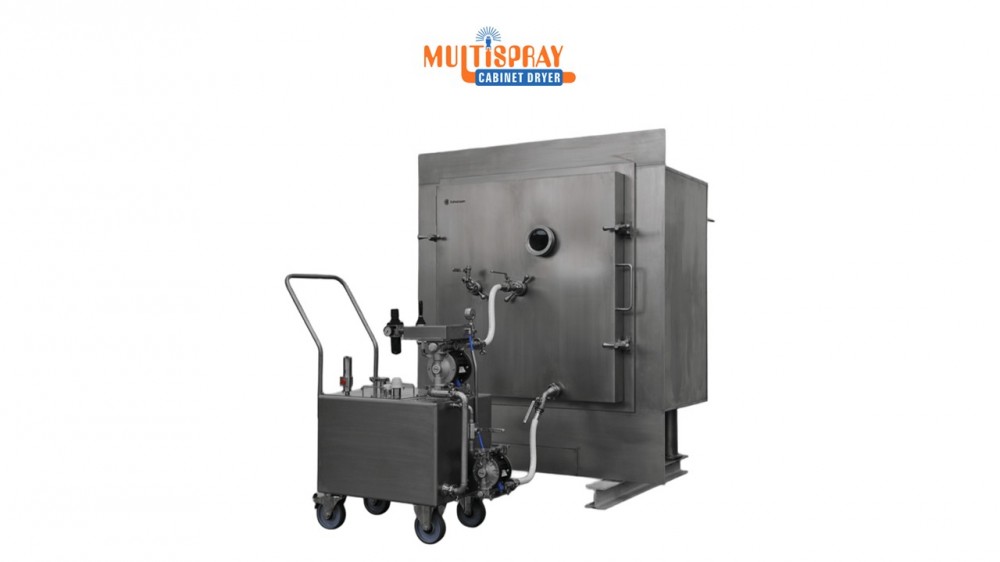
Image 1
Multispray: static vacuum cabinet dryer with fixed or flexible heated shelves
Rotary vacuum dryers (Conical dryers)
In rotary vacuum dryers, the chamber rotates or an internal screw continuously agitates the product in contact with the heated walls. Agitation constantly renews the exposed surface, accelerating mass transfer in the falling rate phase. They are indicated for powders and pastes with good mechanical resistance; they are not recommended for friable or crystalline products that do not tolerate abrasion.
Horizontal vacuum dryers with agitator (Paddle dryers)
Heated paddles rotate slowly in the product bed, combining direct conduction heat transfer and gentle mixing. These horizontal vacuum dryers with agitators (often called paddle dryers) represent an effective compromise between efficiency and product respect. Among the implementations of this type is the Planex® by Italvacuum, a horizontal dryer with an eccentric agitator designed to ensure drying uniformity and gentle product treatment.
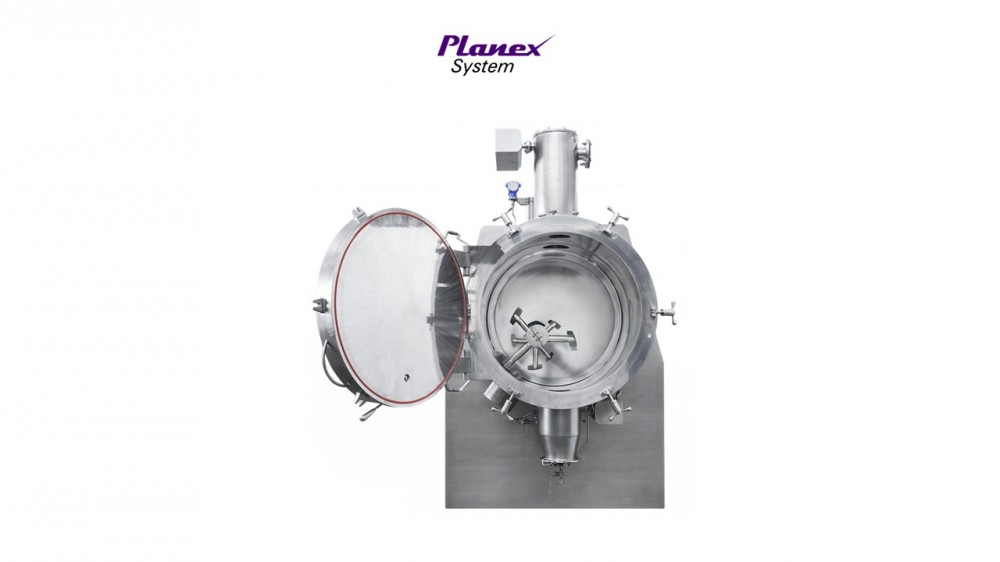
Image 2
Planex: multi-patented horizontal paddle vacuum dryer with concentric agitator
Vacuum fluid bed dryers
Agitation is pneumatic, achieved with recirculating inert gas. The vacuum fluid bed guarantees homogeneous treatment and reduced cycle times but requires products with adequate particle size to support fluidization.
Hybrid microwave technologies
Dielectric heating generates heat volumetrically within the product, eliminating the external-internal thermal gradient. Particularly effective in the falling rate phase, where internal moisture migration is the bottleneck. Capital costs are higher and industrial scalability requires careful design.
The condensation system: a critical element
An element often underestimated in selection is the condensation system or condensing unit. The condenser, positioned between the chamber and the vacuum pump, must be dimensioned for the maximum vapor flow — which typically concentrates in the initial peak of the cycle — and for a condensation temperature suitable for the solvent treated. A sub-dimensioned vacuum condensing unit does not protect the pump and compromises the achievement of the operating vacuum. In modern plants, the continuous measurement of condensate, combined with residual pressure, provides an indicator of the moisture content in the product, allowing for the automation of the end-of-cycle point.
Read also:
The advantages of the condensation unit in vacuum drying: efficiency and solvent recovery
Advantages of vacuum drying compared to hot air
Operating in a confined, low-pressure environment is not just a technical choice: it translates into a series of operational, safety, and regulatory advantages that convective hot air cannot offer.
Thermal protection
By lowering the pressure, the solvent evaporates at temperatures close to ambient, eliminating the risk of thermal degradation. For pharmaceutical (APIs) and food products, this means preserving active ingredients, protein structures, and aromatic profiles that conventional drying at 80–120 °C would irreversibly compromise. The operating thermal delta compared to hot air is typically 70–80 °C.
ATEX safety and absence of oxygen
ATEX (from the French acronym ATmosphères EXplosibles) indicates the European regulation — Directive 2014/34/EU — which regulates the use of equipment in potentially explosive environments. When drying products with flammable organic solvents (acetone, ethanol, IPA...), a convective dryer introduces air, creating vapor-oxygen mixtures that can reach the flammability range. The vacuum dryer operates in a closed system and in the almost total absence of oxygen: the risk of an explosive atmosphere is eliminated at the source.
Solvent recovery
The solvent vapor extracted from the chamber is condensed and collected in pure liquid form, ready to be reintroduced into the production cycle. VOC (Volatile Organic Compounds) emissions are practically zero, with direct benefits for environmental compliance, disposal costs, and the process mass balance.
Product purity and containment
The closed system prevents any cross-contamination between the product and the external environment. For the processing of HPAPI (Highly Potent Active Pharmaceutical Ingredients), this translates into bidirectional protection: the product does not contaminate the operator, and the environment does not contaminate the product. Cleaning and changeover procedures are simplified, with a direct impact on plant downtime.
Vacuum drying and Industry 4.0: how to optimize the process
Vacuum drying lends itself naturally to automation because its key parameters — pressure, condenser temperature, amount of condensate collected — are measurable continuously and in real-time. This makes them a valuable source of information on the state of the product during the cycle.
In more advanced systems, these data are not limited to monitoring: they are processed by control algorithms that automatically adjust the pressure and temperature profile batch by batch, correcting variations in raw material characteristics on the fly. The goal is to reach the end-of-drying point at the right moment — neither too early, risking a still-moist product, nor too late, wasting energy and machine time.
The most advanced systems integrate predictive models trained on historical production data, capable of anticipating when the product has reached the moisture target even before the sensors register it. This is the practical application of Process Analytical Technology (PAT) principles, the approach promoted by pharmaceutical regulatory authorities to replace end-of-batch controls with continuous and documented knowledge of the process.
Is vacuum drying the right choice for your process?
Vacuum drying operates on distinct physical principles compared to convective hot air and enables applications that would otherwise be impossible. However, it is not the universal answer. For thermostable, non-oxidizable products without solvents to recover, a convective hot air dryer remains the simplest and most economical solution. Vacuum becomes the mandatory choice — and often the only technically feasible one — in three precise scenarios: when the product does not tolerate heat, when the presence of flammable organic solvents requires the exclusion of oxygen, and when the solvent has an economic or environmental value that makes its recovery mandatory.
This is precisely where Italvacuum operates: pharmaceutical, fine chemical, chemical, and nutraceutical sectors. Sectors where final product quality, process safety, and regulatory compliance admit no compromises — and where the choice of drying technology can make the difference between a robust process and a vulnerable one.
You might also be interested in:
Drying technologies in the pharmaceutical, chemical and nutraceutical sectors