 ENG
ENG ITA
ITA FRA
FRA ESP
ESP DEU
DEU
In industrial powder and granular material processing, the formation of agglomerates can compromise product flowability, particle size uniformity and production process continuity.
To restore a more homogeneous particle size distribution, lump breakers are used: mechanical deagglomeration systems designed to break up agglomerates that may form during the various processing stages.
The main configurations available include electrically driven and pneumatically driven lump breakers. Both technologies perform the same basic function, but differ in terms of process control, performance, energy efficiency and operating conditions.
An electric lump breaker uses a motor to transmit rotary motion to the crushing elements, generally consisting of blades mounted on a shaft.
The combined action of cutting, impact and compression breaks down lumps and restores a more uniform particle size distribution, supporting a continuous product flow through the subsequent processing stages.
One of the distinctive features of the electric drive is control via an inverter (VFD – Variable Frequency Drive), which continuously regulates shaft speed and blade tip speed, with an operating range that can reach up to 870 rpm.
Speed can be adjusted according to product characteristics and process requirements, adapting the intensity of the mechanical action to powders and granules with different levels of cohesion, residual moisture, bulk density or tendency to agglomerate.
The ability to precisely adjust speed and torque also helps reduce mechanical stress on rotating components and ensures greater operating stability, making the electric lump breaker particularly suitable for continuous processes and applications requiring precise treatment control.
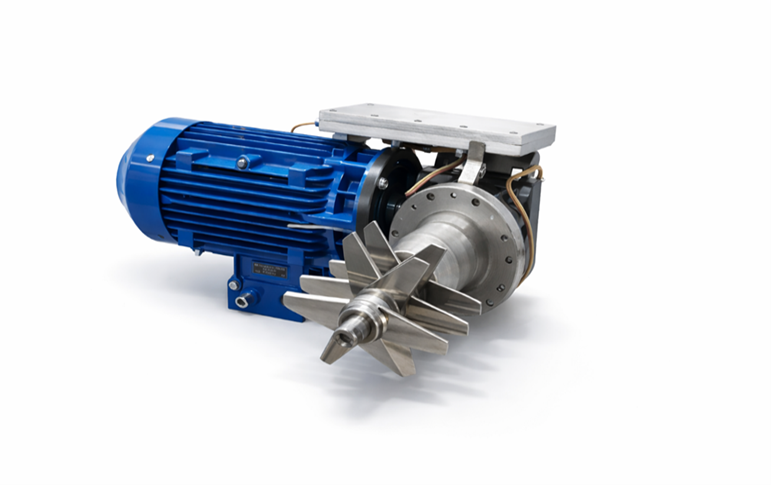 Italvacuum lump breaker with electric drive.
A pneumatic lump breaker uses compressed air to transmit motion to the crushing elements.
The system typically operates at pressures between 4 and 7 bar, and the actuation frequency can be adjusted according to operating requirements and the characteristics of the material being processed.
From an application standpoint, pneumatic lump breakers are generally used for intermittent operation. Compared with electric drives, they offer lower crushing capacity and less precise control of operating parameters, making them more suitable for applications where high deagglomeration power is not required.
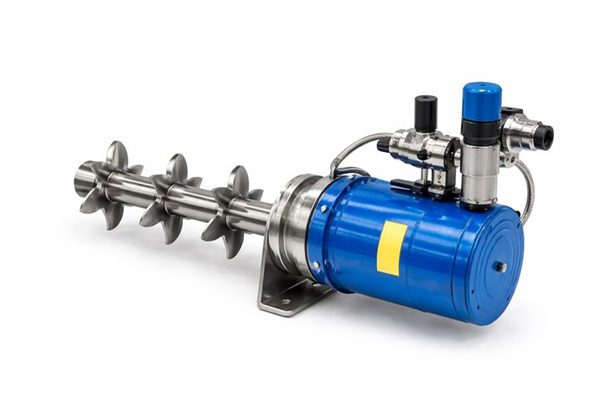
Lump breaker with pneumatic drive.
One of the most significant differences between the two technologies is the energy efficiency of the drive system.
The technical analysis compared an ATEX-certified three-phase electric motor with an equivalent pneumatic motor, considering a useful mechanical power output of 3.8 kW and an estimated 2,000 operating hours per year for both.
Under the conditions considered, the values differ significantly:
ATEX ELECTRIC MOTOR
Overall efficiency: ≈ 90%
Consumption: 8,444 kWh/year
PNEUMATIC MOTOR
Overall efficiency: ≈ 15%
Consumption: 50,667 kWh/year
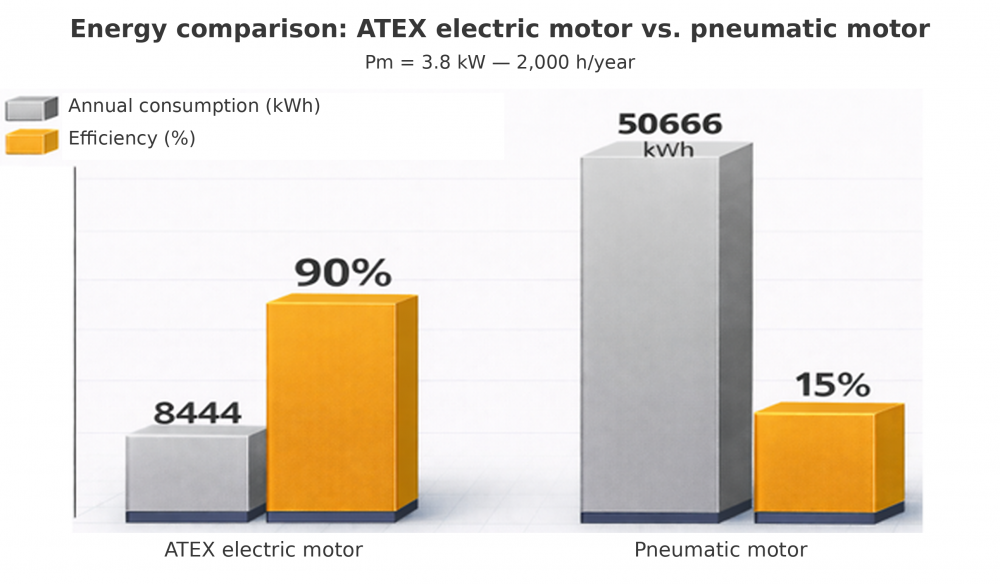
Energy comparison between an ATEX electric motor and a pneumatic motor at the same useful mechanical power (3.8 kW) and over 2,000 operating hours per year.
In the second case, the calculation considers the entire energy chain, including the compressor and losses associated with the compressed-air network.
For the same useful mechanical power output, in the case analysed the pneumatic system therefore requires approximately six times as much electrical energy as the electric solution.
The difference is mainly due to losses occurring during air compression, distribution and expansion, as well as internal friction in the pneumatic motor.
In continuous processes, this higher energy demand can translate into a higher cost per unit of product and lower overall system efficiency.
The difference in energy consumption is also reflected in the indirect CO₂ emissions associated with the energy used.
Assuming, as in the analysis, an average European grid emission factor of between 0.25 and 0.30 kg CO₂ per kWh, the energy consumption values considered correspond to:
The choice between the two technologies should take into account product characteristics, frequency of use and operating conditions.
An electric lump breaker is particularly suitable when:
For several decades, Italvacuum has been developing solutions for handling and processing powders under complex process conditions. As early as 1989, with the development of the first CRIOX® System, the company introduced equipment designed to process sensitive products under vacuum and in controlled environments.
talvacuum uses electric lump breakers in its process equipment, designed to break up agglomerates that may form during powder processing, drying or handling.
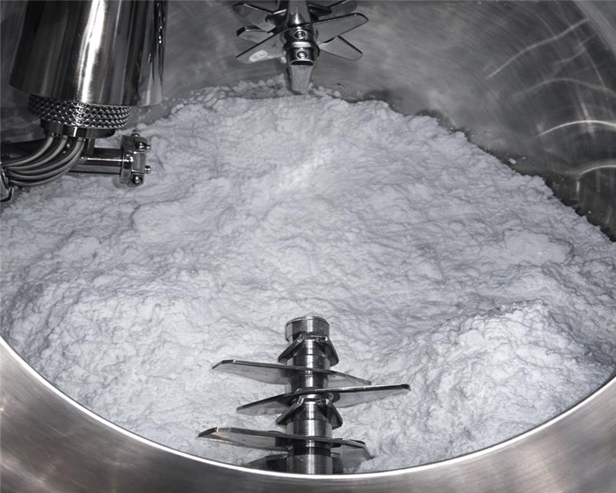 Lump breaker integrated into the process system to break down agglomerates during powder processing.
Their integration into process systems helps maintain a more uniform particle size distribution, improve product flowability and ensure continuity in subsequent processing stages.
Italvacuum lump breakers are available in ATEX versions for use in potentially explosive atmospheres, are designed in compliance with CE requirements and manufactured in accordance with FDA and cGMP standards.
The use of materials such as AISI 316L and C22 also provides corrosion resistance and compatibility with critical applications in the pharmaceutical, chemical and fine chemical.
The choice between electric and pneumatic drive does not only concern the operation of the lump breaker: it can affect process control, operating continuity, energy consumption and the overall energy efficiency of the plant.
Evaluating the system according to product characteristics and operating conditions makes it possible to identify the configuration best suited to the specific application.
Would you like to identify the lump breaker configuration best suited to your process?
Contact the Italvacuum team to discuss your application requirements and evaluate the solution that best meets your needs.
To restore a more homogeneous particle size distribution, lump breakers are used: mechanical deagglomeration systems designed to break up agglomerates that may form during the various processing stages.
The main configurations available include electrically driven and pneumatically driven lump breakers. Both technologies perform the same basic function, but differ in terms of process control, performance, energy efficiency and operating conditions.
How does an electric lump breaker work?
An electric lump breaker uses a motor to transmit rotary motion to the crushing elements, generally consisting of blades mounted on a shaft.
The combined action of cutting, impact and compression breaks down lumps and restores a more uniform particle size distribution, supporting a continuous product flow through the subsequent processing stages.
One of the distinctive features of the electric drive is control via an inverter (VFD – Variable Frequency Drive), which continuously regulates shaft speed and blade tip speed, with an operating range that can reach up to 870 rpm.
Speed can be adjusted according to product characteristics and process requirements, adapting the intensity of the mechanical action to powders and granules with different levels of cohesion, residual moisture, bulk density or tendency to agglomerate.
The ability to precisely adjust speed and torque also helps reduce mechanical stress on rotating components and ensures greater operating stability, making the electric lump breaker particularly suitable for continuous processes and applications requiring precise treatment control.
Italvacuum lump breaker with electric drive.
How does a pneumatic lump breaker work?
A pneumatic lump breaker uses compressed air to transmit motion to the crushing elements.
The system typically operates at pressures between 4 and 7 bar, and the actuation frequency can be adjusted according to operating requirements and the characteristics of the material being processed.
From an application standpoint, pneumatic lump breakers are generally used for intermittent operation. Compared with electric drives, they offer lower crushing capacity and less precise control of operating parameters, making them more suitable for applications where high deagglomeration power is not required.
Lump breaker with pneumatic drive.
Electric vs pneumatic: efficiency and energy consumption
One of the most significant differences between the two technologies is the energy efficiency of the drive system.
The technical analysis compared an ATEX-certified three-phase electric motor with an equivalent pneumatic motor, considering a useful mechanical power output of 3.8 kW and an estimated 2,000 operating hours per year for both.
Under the conditions considered, the values differ significantly:
ATEX ELECTRIC MOTOR
Overall efficiency: ≈ 90%
Consumption: 8,444 kWh/year
PNEUMATIC MOTOR
Overall efficiency: ≈ 15%
Consumption: 50,667 kWh/year
Energy comparison between an ATEX electric motor and a pneumatic motor at the same useful mechanical power (3.8 kW) and over 2,000 operating hours per year.
In the second case, the calculation considers the entire energy chain, including the compressor and losses associated with the compressed-air network.
For the same useful mechanical power output, in the case analysed the pneumatic system therefore requires approximately six times as much electrical energy as the electric solution.
The difference is mainly due to losses occurring during air compression, distribution and expansion, as well as internal friction in the pneumatic motor.
In continuous processes, this higher energy demand can translate into a higher cost per unit of product and lower overall system efficiency.
What about the environmental impact?
The difference in energy consumption is also reflected in the indirect CO₂ emissions associated with the energy used.
Assuming, as in the analysis, an average European grid emission factor of between 0.25 and 0.30 kg CO₂ per kWh, the energy consumption values considered correspond to:
- ATEX electric motor: approximately 2.1–2.5 tonnes of CO₂/year
- Pneumatic motor: approximately 12.6–15.2 tonnes of CO₂/year
Electric or pneumatic lump breaker: which one should you choose?
The choice between the two technologies should take into account product characteristics, frequency of use and operating conditions.
An electric lump breaker is particularly suitable when:
- the process is continuous or operates at high intensity;
- precise speed and torque control is required;
- the mechanical action must be adapted to the characteristics of the powder;
- energy efficiency and consumption optimisation are important criteria.
- operation is predominantly intermittent;
- high deagglomeration power is not required;
- simplicity and robustness are priority requirements.
Italvacuum's electric lump breakers for powder processing
For several decades, Italvacuum has been developing solutions for handling and processing powders under complex process conditions. As early as 1989, with the development of the first CRIOX® System, the company introduced equipment designed to process sensitive products under vacuum and in controlled environments.
talvacuum uses electric lump breakers in its process equipment, designed to break up agglomerates that may form during powder processing, drying or handling.
Lump breaker integrated into the process system to break down agglomerates during powder processing.
Their integration into process systems helps maintain a more uniform particle size distribution, improve product flowability and ensure continuity in subsequent processing stages.
Italvacuum lump breakers are available in ATEX versions for use in potentially explosive atmospheres, are designed in compliance with CE requirements and manufactured in accordance with FDA and cGMP standards.
The use of materials such as AISI 316L and C22 also provides corrosion resistance and compatibility with critical applications in the pharmaceutical, chemical and fine chemical.
A choice that affects the entire process
The choice between electric and pneumatic drive does not only concern the operation of the lump breaker: it can affect process control, operating continuity, energy consumption and the overall energy efficiency of the plant.
Evaluating the system according to product characteristics and operating conditions makes it possible to identify the configuration best suited to the specific application.
Would you like to identify the lump breaker configuration best suited to your process?
Contact the Italvacuum team to discuss your application requirements and evaluate the solution that best meets your needs.